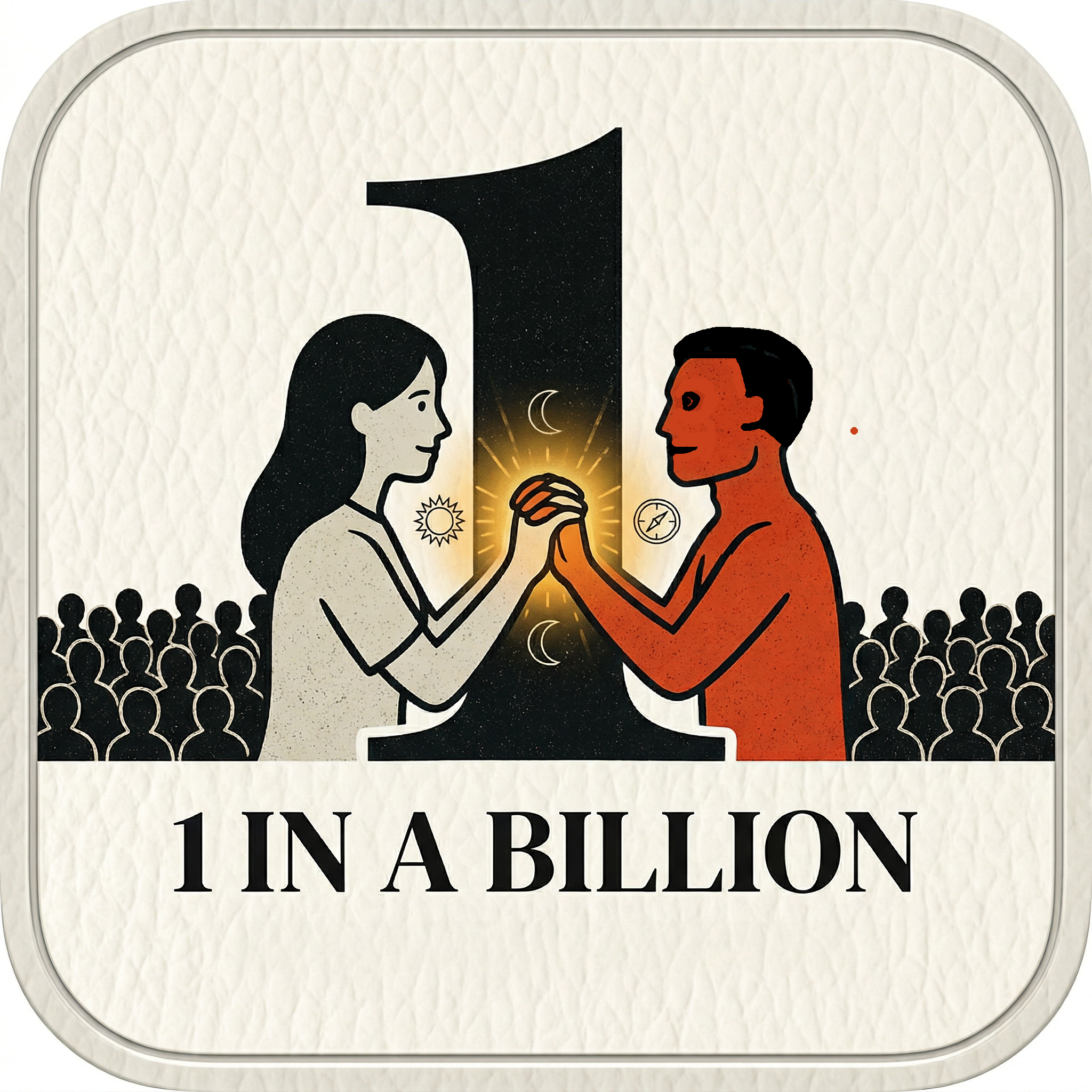
A thesis in twenty parts
The Mirror and the Algorithm
On self-knowledge, ancient diagnostic systems, and why the most honest thing anyone has ever said about you was computed from the coordinates of your birth.
The Problem with Knowing Yourself
Socrates said it two and a half thousand years ago and we have been failing at it ever since. Know thyself. The instruction carved above the entrance to the Temple of Apollo at Delphi, repeated by every philosophical tradition that followed, and yet still the hardest thing any human being is ever asked to do.
The difficulty is not effort. The difficulty is structure. We cannot see ourselves because the instrument of observation is the thing being observed. The eye cannot look at itself without a mirror. The psyche cannot examine itself without a frame that is external to it. Every honest attempt at self-knowledge runs into the same recursive problem: the mind that is doing the looking is the same mind whose blind spots, defense mechanisms, and unconscious patterns are the very things it needs to see.
Foucault, in his late lectures at the College de France, traced what he called the care of the self across Greco-Roman antiquity and early Christianity. He showed that self-knowledge was never understood as introspection in the modern sense -- not a private act of turning inward, but a practice embedded in community, mentorship, and externally structured techniques. The Stoics kept journals not to express their feelings but to audit their judgments against an objective standard. Seneca's evening self-examination was not therapy; it was an accounting. The self was understood as something that required tools, practices, and external frames in order to become visible to itself. The modern assumption that we can simply look inward and find truth is a historical anomaly, not a perennial wisdom.
Kierkegaard understood this even more sharply. Subjectivity, he argued, is not a fixed thing that can be known the way an object is known. The self is a relation that relates to itself, and in that relating, it is constantly in motion. You are not a static entity that can be photographed from the correct angle. You are a process -- a becoming -- and any attempt to capture that process from inside the process itself produces not knowledge but anxiety. This is the existential vertigo that drives people toward systems, labels, and types: not because they are lazy, but because the alternative -- sitting with the radical uncertainty of self-observation without any external frame -- is genuinely unbearable.
Therapy tries. And therapy, at its best, succeeds -- partially. A skilled therapist provides an external frame: their training, their observation, their willingness to sit with the patient in the uncomfortable territory between self-image and reality. But therapy is constrained by the therapeutic relationship itself. The patient brings their persona into the room. They perform, even when they are trying not to. They edit. They present the version of the story that protects them from the parts they cannot yet face. The transference distorts. The countertransference distorts further. The therapeutic frame is external, but it is not independent. It is contaminated by the very relationship it is trying to illuminate.
I built 1 in a Billion because I wanted to solve this problem. Not by replacing therapy or personality assessment, but by providing a mirror that does not depend on self-report, does not depend on performance, and does not depend on the observer's relationship with the subject. A mirror computed from data that you did not generate, cannot fake, and cannot edit: the time and place of your birth.
This essay is an attempt to explain the intellectual architecture behind what that mirror does, why it works the way it works, and what happens when people encounter a portrait of themselves that they did not author and cannot dismiss.
The Failure of the Profile
Modern technology has given us an unprecedented number of ways to represent ourselves, and almost all of them are lies. Not deliberate deception, necessarily, but structural lies -- distortions built into the medium itself.
A dating profile is a marketing document. You select your best photos, write a bio that positions you as interesting but not desperate, curate interests that signal the identity you want to project. The resulting artifact tells the reader almost nothing about who you actually are. It tells them who you want to be seen as. These are different things, and the gap between them is where most relationship failure begins.
Walter Mischel's work on the personality paradox, beginning in the late 1960s, demonstrated something that the personality psychology establishment found deeply uncomfortable: that personality traits as measured by questionnaires are remarkably poor predictors of actual behavior in specific situations. A person who scores high on conscientiousness may be punctual at work and chaotic at home. A person who tests as extraverted may be gregarious with friends and withdrawn with strangers. The cross-situational consistency that trait theory assumes turns out to be far weaker than anyone expected. Mischel did not conclude that personality does not exist. He concluded that the instruments we use to measure it are capturing something closer to self-concept than to the underlying architecture of the psyche.
The Big Five model -- openness, conscientiousness, extraversion, agreeableness, neuroticism -- is the most empirically validated framework in personality psychology, and its limitations are instructive. It predicts aggregate behavioral tendencies across populations with reasonable accuracy. What it cannot do is tell you why your relationships fail in the same way every time, why you sabotage yourself at the exact moment of success, why certain people trigger a reaction in you that is wildly disproportionate to anything they actually did. These are not behavioral tendencies. They are structural patterns. They belong to the architecture of the psyche, and no self-report questionnaire will surface them, because they operate beneath the level of conscious self-assessment.
The behavioral data that platforms collect about you -- what you click, how long you scroll, what you buy -- captures preferences and habits with staggering precision. But preferences are not personality. Habits are not character. A corporation can predict what you will purchase next with 94% accuracy and still have no insight whatsoever into the unconscious forces that shape your life. These forces do not leave behavioral traces that recommendation engines can detect. They are constitutional. They belong to the substrate, not the surface.
Why Birth Data
The use of birth data as a diagnostic coordinate is not a belief system. It is a methodology with a lineage of over four thousand years. The earliest known horoscopic texts come from Mesopotamia -- Babylonian birth charts dating to the fifth century BCE that record planetary positions at the moment of birth and correlate them with the character and fate of the individual. Egyptian decans mapped the sky into 36 ten-degree segments tied to the rising of specific star groups, each associated with particular qualities of time and temperament. Greek astrology, codified by Ptolemy in the Tetrabiblos around 150 CE, synthesized Babylonian observational data with Greek philosophical categories, producing the system of signs, houses, and aspects that Western astrology still uses today. Indian Jyotish, documented in texts dating to the early centuries CE but drawing on observational traditions far older, developed independently with its sidereal zodiac and nakshatra system. Chinese astrology mapped the heavens through an entirely different framework of twelve earthly branches and ten heavenly stems, arriving at a system that is structurally distinct from both Western and Indian traditions yet shares the foundational premise: that the moment of birth is not arbitrary.
Five major civilizations. Independent development. Different zodiacs, different calculation methods, different philosophical frameworks. They agree on one thing: the configuration of the heavens at the moment a person enters the world corresponds to something real about that person. The mechanism they propose is not causal in the way modern science requires causation to work. The planets do not beam down influences like radio towers. What these traditions describe is closer to what Jung called synchronicity: a meaningful coincidence between an outer configuration and an inner reality.
Jung's engagement with astrology was not casual. He cast horoscopes for his patients as a parallel diagnostic lens. In a 1954 letter to the Indian astrologer B. V. Raman, he wrote that he had observed cases where the astrological data illuminated psychological dynamics in ways that his clinical methods alone could not reach. He did not claim that astrology worked through planetary causation. He proposed something more subtle: that the birth chart and the psyche are two expressions of the same moment in time, related not by cause and effect but by meaning. The clock does not cause the meeting to happen. But the clock and the meeting correspond, and that correspondence is not random.
Birth data has a property that no other input to a psychological profile possesses: it is objective, immutable, and independent of the subject's self-perception. You cannot edit your time of birth. You cannot curate it. You cannot perform a more attractive version of it. It is a fixed coordinate in spacetime, and any system that takes that coordinate as input will produce the same output regardless of how you feel about yourself, what story you tell about your life, or what persona you have constructed to navigate the world.
This is why the output can be so confronting. When a reading describes a pattern in your psychology that you recognize but have never articulated -- a specific mode of self-sabotage, a particular shape of emotional reactivity, a recurring dynamic in your relationships -- the confrontation is not with someone's opinion of you. It is with a computation that had no opinion. It processed coordinates. And the coordinates described something you were not ready to hear.
Why Five Systems
If one diagnostic system can produce a useful portrait, why use five? The answer is triangulation -- the same principle that underlies every serious diagnostic methodology in medicine, intelligence analysis, and the sciences. A single data source produces a reading. Multiple independent data sources, converging on the same observation, produce a diagnosis.
Consider medical imaging. An X-ray shows bone structure but misses soft tissue pathology. An MRI shows soft tissue but cannot image metabolic activity. A PET scan reveals metabolic hotspots but lacks anatomical detail. No physician would argue that one modality is sufficient for a complex case. The most accurate diagnosis comes from the synthesis -- the moment when the X-ray and the MRI and the PET scan all point to the same region, the same anomaly, from different angles and through different physical principles. That convergence is not redundancy. It is signal amplification.
Each of the five systems we compute operates as an independent diagnostic lens. They use different inputs, different calculation methods, different conceptual frameworks. They are not redundant. They are orthogonal -- each sees a dimension of the psyche that the others do not address. Western astrology maps the psychological interior. Vedic astrology maps karma and time. Human Design maps energetic mechanics. Gene Keys maps the evolution of consciousness. Kabbalah maps the soul's architecture.
When all five systems converge on the same observation -- when Western astrology sees a Venus-Saturn wound, Vedic astrology confirms it with a specific dasha timing, Human Design shows an undefined Emotional Solar Plexus, Gene Keys identifies the Shadow frequency in the Venus Sequence, and Kabbalah maps an imbalance between Netzach and Gevurah -- you are no longer looking at an astrological opinion. You are looking at a convergence across five independent coordinate systems. The probability that five independent systems would produce the same observation by chance is vanishingly small. The signal-to-noise ratio changes completely.
Western Astrology: The Psychological Map
Carl Gustav Jung kept a quiet practice that few of his colleagues knew about. For years, he cast horoscopes for his patients. Not as a diagnostic tool to be published in journals, but as a parallel lens -- a way of seeing the psyche's architecture from an angle that his typology and dream analysis could not always reach. He did not claim that astrology worked through planetary causation. He proposed something more subtle: synchronicity. The meaningful coincidence between celestial configuration and psychological state.
Jung's engagement with astrology was sustained and serious. His famous 1954 letter to B. V. Raman, the Indian astrologer and editor of The Astrological Magazine, acknowledged that he had observed cases where astrological data illuminated psychological dynamics in ways that clinical methods alone could not. His concept of archetypes -- universal patterns of meaning shared across cultures and operating beneath the threshold of individual consciousness -- mapped naturally onto the planetary symbols that astrologers had been working with for millennia. Saturn as the archetype of limitation, structure, and the father wound. Venus as the archetype of desire, beauty, and relational bonding. Pluto as the archetype of death, transformation, and the underworld of the unconscious. These were not metaphors Jung layered onto astrology. They were convergences he observed between his clinical work and the astrological tradition.
Liz Greene, the American-British astrologer and Jungian analyst, took this convergence and built an entire school of thought on it. Together with Howard Sasportas, she founded the Centre for Psychological Astrology in London, producing a body of work that remains the most rigorous integration of depth psychology and astrology in the Western tradition. Greene demonstrated that the natal chart could be read as a map of the psyche -- not as a prediction of events, but as a portrait of the inner world. The Sun as conscious identity. The Moon as the emotional substrate and the internalized mother. The Ascendant as the persona -- the mask the psyche constructs to interface with the world. Saturn as the wound that structures the personality through limitation and fear, producing the compensatory behaviors that Adler would have recognized as guiding fictions.
What makes Western astrology uniquely powerful for individual portraiture is its capacity for synastry: the technique of overlaying two natal charts to see how they interact. When one person's Moon falls on another person's Saturn, that relationship carries a particular emotional weight -- a sense of duty, restriction, or parental dynamic that both parties feel but may not be able to articulate. When one person's Venus conjuncts another's Pluto, the relationship contains an intensity of desire and transformation that can be profoundly intimate or profoundly destructive, and usually both. Synastry does not tell you whether a relationship is good or bad. It tells you what the relationship is -- what it activates in each person's chart, what parts of the psyche it brings to the surface, what unconscious material it forces into visibility.
The tropical zodiac that Western astrology uses is anchored to the seasons rather than to the fixed stars. This is not an error or a simplification. It is a philosophical choice that aligns with the Western psychological orientation toward selfhood, individuation, and the phenomenology of lived experience. The tropical zodiac tracks the relationship between the Earth and the Sun -- the cycle of light and darkness, growth and withdrawal, that structures human experience of time. It is, in Husserl's sense, a phenomenological coordinate system: it maps the world as experienced, not the world as it exists independently of the observer.
Vedic Astrology: Karma and Time
Jyotish -- the Sanskrit name means "science of light" -- is the oldest continuously practiced astrological tradition on earth, codified in texts dating back over two thousand years. Where Western astrology uses the tropical zodiac aligned to the seasons, Jyotish uses the sidereal zodiac, aligned to the actual positions of the fixed stars. Due to the precession of the equinoxes, these two zodiacs have drifted approximately 24 degrees apart. A person who is an Aries Sun in Western astrology may be a Pisces Sun in Vedic. This is not an error. It is a different measurement frame -- the sidereal frame tracking the cosmic backdrop rather than the seasonal cycle, anchoring the chart to the fixed stars rather than to the Earth-Sun relationship.
The sidereal frame matters because Jyotish is fundamentally concerned with karma -- the accumulated momentum of past actions, in this life and in previous ones. The fixed stars provide a stable reference grid against which the movements of the planets trace out the patterns of karmic unfolding. Where Western astrology asks "Who am I?", Jyotish asks "What have I brought with me, and when will it manifest?"
The temporal engine of Jyotish is the Vimshottari Dasha system, and it is unlike anything in Western astrology. Based on the Moon's exact position within its nakshatra (lunar mansion) at birth, the dasha system assigns a sequence of planetary periods that span the entirety of a 120-year human life. Each planet rules for a fixed number of years: Venus for 20, Sun for 6, Moon for 10, Mars for 7, Rahu for 18, Jupiter for 16, Saturn for 19, Mercury for 17, Ketu for 7. These major periods (Mahadashas) subdivide into sub-periods (Antardashas), and those further subdivide into sub-sub-periods (Pratyantar Dashas). The result is a temporal map of extraordinary precision -- not just what is in your chart, but when each part of it activates, down to specific windows of weeks and months.
We built seven computational engines to handle the depth of Jyotish properly. This was not a design choice made for marketing purposes. It was a requirement imposed by the tradition itself, as specified in the foundational texts -- primarily the Brihat Parashara Hora Shastra, attributed to the sage Parashara, and the Surya Siddhanta, the classical text on astronomical calculation.
The Seven Engines
1. Shadbala -- six-fold planetary strength, measuring whether a planet can actually deliver on its promises through positional, directional, temporal, motional, natural, and aspectual strength components. 42 individual strength scores per chart.
2. Ashtakavarga -- 672 individual bindu (point) lookups that map the benefic-point landscape of the chart across all twelve signs for all seven classical planets.
3. Vimshottari Dasha -- three levels deep: Mahadasha, Antardasha, and Pratyantar Dasha, computed from the Moon's exact fractional position within its birth nakshatra. 729 period boundaries per person.
4. Mrityu Yoga -- detection of planets at the classical death-degree positions documented in Chapter 44 of the Brihat Parashara Hora Shastra.
5. Kaal Sarp Yoga -- arc geometry analysis to determine whether all seven visible planets are hemmed between the Rahu-Ketu axis, including partial formation detection and classification into twelve named serpent types.
6. Combustion -- angular distance calculations between the Sun and each planet, using planet-specific and motion-specific orb thresholds from the Surya Siddhanta, with three severity tiers.
7. Gandanta -- junction analysis at the three water-fire boundaries of the zodiac, with proximity grading and nakshatra transition identification.
Each of these engines performs computations that a traditional Jyotishi would spend hours or days calculating by hand. The algorithms are not approximations. They follow the classical procedures specified in the source texts, with the numerical thresholds, sign-based tables, and calculation sequences the tradition prescribes. A chart either has Kaal Sarp or it does not. A planet either meets the combustion threshold or it does not. A Shadbala score is a number, not an adjective. The computation is deterministic, reproducible, and falsifiable -- which is more than most personality assessments can claim.
Human Design: The Bodygraph
In January 1987, a man named Robert Alan Krakower had an experience on the Spanish island of Ibiza that he described as eight days and nights of continuous revelation. He emerged with a system -- a synthesis of four ancient traditions into a single framework -- and a new name: Ra Uru Hu. Whether one accepts the origin story or not, the system he produced is intellectually remarkable. Human Design combines the 64 hexagrams of the I Ching, the Kabbalistic Tree of Life, the Hindu-Brahmin chakra system, and elements of quantum physics into a bodygraph: a schematic of the human energy system that is calculated from two sets of birth data -- the moment of birth (Personality) and a point approximately 88 days before birth (Design, representing what the system calls the soul's entry into the body).
The bodygraph contains nine centers (analogous to but distinct from the seven traditional chakras), 36 channels (connecting the centers), and 64 gates (one for each I Ching hexagram, located within the channels). Each center can be defined (colored in, operating consistently from an internal source) or undefined (white, receptive, absorbing and amplifying the energy of others). Each gate can be activated or dormant. A channel is defined only when both its gates are activated -- the energy flows through it consistently. A center is defined when at least one of its channels is complete.
From the configuration of centers and channels, the system derives four fundamental Types -- Manifestors, Generators (including Manifesting Generators), Projectors, and Reflectors -- each with its own Strategy for correct decision-making and Authority for accessing inner truth. A Generator is designed to respond to life rather than initiate. A Projector is designed to wait for recognition and invitation. A Manifestor is designed to inform before acting. A Reflector, with no defined centers at all, is designed to wait a full lunar cycle before making major decisions. These are not personality types in the Big Five sense. They are mechanical descriptions of how energy operates in a particular body.
What makes Human Design uniquely powerful for relationship analysis is the concept of electromagnetic connections. When two people come together, their bodygraphs overlay. A gate activated in one person may complete a channel in the other, creating a defined channel that exists only when they are together. This is an electromagnetic connection: neither person has this energy alone, but together they generate it. The attraction between them is not merely psychological or chemical. It is architectural -- the bodygraph literally changes shape in the other person's presence.
Compromise channels are equally revealing. When two people both have one gate of a channel defined but neither has the other gate, a compromise exists: both people are reaching toward the same energetic expression but cannot quite complete it together. The energy is present but unresolved. In an intimate relationship, this can manifest as a persistent sense of almost-but-not-quite understanding -- a dynamic that feels tantalizingly close to connection but never fully resolves.
Gene Keys: From Shadow to Gift
Richard Rudd was a student of Ra Uru Hu who took the 64 gates of Human Design and reframed them as 64 Gene Keys -- spectra of consciousness, each moving through three frequencies. The Shadow is the unconscious, fear-based expression of the key. The Gift is what emerges when the shadow is met with awareness and acceptance rather than repression or acting out. The Siddhi is the transcendent frequency -- not an achievement but a grace, a state of consciousness in which the original wound becomes a source of extraordinary contribution. The movement from Shadow to Gift to Siddhi is not a ladder to be climbed. It is a process of deepening contemplation that can take years or a lifetime.
Where Human Design is mechanical and descriptive -- this is how your energy works -- Gene Keys is contemplative and transformational -- this is what happens when you bring sustained awareness to each frequency in your chart. The system does not tell you what you are. It shows you what you are becoming, and what is preventing the becoming.
The architecture of exploration in Gene Keys is organized into three sequences, collectively called the Golden Path. The Activation Sequence maps your life's purpose through four keys: Life's Work (your conscious sun), Evolution (your conscious earth), Radiance (your design sun), and Purpose (your design earth). These four keys form the foundation of your individual journey. The Venus Sequence maps the landscape of relationships and intimacy through keys derived from the planetary positions associated with Venus and Mars, as well as your emotional wound pattern. This is where Gene Keys addresses the question of why we attract the partners we attract and what our relationships are asking us to transform. The Pearl Sequence maps prosperity and vocation -- the form through which your gift meets the world.
For relationship analysis, the Venus Sequence is where the real depth lives. Each person carries wound patterns in their Venus Sequence -- specific shadows around intimacy, emotional openness, and relational trust that were established in early childhood and reinforced through every subsequent relationship. When two people's Venus Sequences are compared, the Gene Keys framework reveals not just whether they are compatible in some generic sense, but what specific shadows each person's presence activates in the other. Your partner does not trigger you randomly. They trigger you precisely -- at the exact frequency where your Venus Sequence wound lives. That precision can be computed. And once computed, it can be described in language that makes both people feel simultaneously understood and exposed.
Kabbalah: The Tree of Life
The Kabbalistic Tree of Life is a map of divine emanation -- ten qualities (Sephiroth) through which the infinite, unknowable Ein Sof manifests into the finite world. Keter (Crown) is the first stirring of will, the point before creation differentiates. Chokmah (Wisdom) is the flash of creative insight, the seed of all potential. Binah (Understanding) is the structuring intelligence that gives form to what Chokmah conceives. Chesed (Lovingkindness) is expansion, generosity, the outpouring of grace. Gevurah (Severity) is contraction, judgment, the boundary that prevents expansion from dissolving into formlessness. Tiferet (Beauty) is the harmonizing center of the self, the integration point where mercy and severity find balance. Netzach (Victory/Endurance) is emotional drive, aesthetic passion, the desire that pulls the soul toward beauty. Hod (Splendor) is intellectual precision, the analytical faculty that structures thought. Yesod (Foundation) is the generative, connective energy -- sexuality, bonding, the bridge between the inner world and the outer. Malkuth (Kingdom) is the manifest world itself -- the body, the material, the place where the soul's journey takes physical form.
Twenty-two paths connect the ten Sephiroth, corresponding to the twenty-two letters of the Hebrew alphabet. Each path represents a process, a transition, a way of moving energy from one quality to another. The Tree is not a hierarchy so much as a circuit diagram of consciousness -- a map of how qualities of being flow into and balance each other.
Mapping birth data onto the Tree is a practice with roots in both Jewish mystical tradition and the Western Hermetic adaptation of Kabbalah that flowered in the Renaissance and was systematized by organizations like the Golden Dawn. Planetary positions correspond to specific Sephiroth: Saturn to Binah, Jupiter to Chesed, Mars to Gevurah, the Sun to Tiferet, Venus to Netzach, Mercury to Hod, the Moon to Yesod. The birth chart, read through the Tree, reveals which archetypal forces are active in a person's soul journey -- where they have strength, where they have imbalance, where the energy flows freely and where it is blocked.
For individual portraiture, Kabbalah offers a framework that no other system in our stack provides: the concept of tikkun. Tikkun means repair or correction. In the Kabbalistic view, each soul incarnates with specific repair work to accomplish -- imbalances in the Tree that were inherited from ancestral patterns or accumulated in previous lifetimes. The unresolved Gevurah (excessive judgment, severity) of a grandfather becomes the corrective work that appears in the grandchild's Tree as an emphasis on Chesed (lovingkindness, expansion). The individual is not merely a self. The individual is a node in a lineage of repair, carrying forward work that extends beyond one lifetime.
This concept of inherited soul-work provides the deepest lens in our system. Where Western astrology sees psychology, Vedic astrology sees karma, Human Design sees mechanics, and Gene Keys sees consciousness evolution, Kabbalah sees the soul's architecture -- the specific configuration of divine qualities that this particular life is here to embody, balance, and repair.
The Mathematics of Multi-System Computation
Let us talk about the combinatorial explosion. A single individual reading across all five systems requires a staggering number of computations. The Western chart alone involves planetary positions in signs and houses, aspects between every pair of planets (with ten planets and five major aspect types, that is roughly 225 aspect checks), dignities, retrogradation, and stellium detection. The Vedic chart requires all seven engines described above. The Human Design bodygraph requires gate calculations at two time points (birth and 88 days prior), center derivation, channel detection, Type and Authority classification. The Gene Key profile requires mapping the gate activations onto three sequences. The Kabbalistic mapping requires planetary-Sephirotic correspondence and path analysis.
Now consider synastry. Two people require all of the above, computed twice individually, and then again in combination. Western synastry involves an aspect grid checking every planet in Chart A against every planet in Chart B. Vedic compatibility runs the Ashtakoota system across eight dimensions: Varna, Vashya, Tara, Yoni, Graha Maitri, Gana, Bhakoot, and Nadi -- each with its own scoring algorithm, dosha detection, and cancellation rules. Human Design overlay identifies electromagnetic connections, compromise channels, and composite definition. Gene Key comparison identifies shared shadows, complementary gifts, and Venus Sequence resonance. Kabbalistic comparison identifies shared Sephirotic emphasis and complementary tikkun patterns.
The numbers
Individual readings: 16 PDF chapters, 50,000+ words, 3+ hours of narrated audio, 5 original songs. Vedic computation alone per person: 672 Ashtakavarga bindu lookups, 42 Shadbala strength scores, 729 dasha period boundaries. Synastry readings: up to 32 chapters analyzing individual portraits plus the relational field. All five systems combined: tens of thousands of individual computations per reading pair. The Ashtakoota system evaluates 8 dimensions with bidirectional Tara calculation and Bhakoot dosha cancellation. Thirteen languages, each generated natively, not translated.
The complexity scales quadratically with each additional person. A matching system that evaluates N users against each other produces N(N-1)/2 pairs. For a thousand users, that is nearly half a million pairs, each requiring the full multi-system synastry computation. The computational infrastructure required to perform this at scale -- reliably, accurately, in real time -- is non-trivial. It is also necessary, because the convergence patterns that carry real signal only emerge when all five systems are computed simultaneously for the same pair.
No human practitioner can perform this synthesis. A skilled Western astrologer might spend hours on a single synastry session. A Jyotishi might spend a day computing Shadbala and Ashtakavarga by hand. No single practitioner commands all five systems, and even if one did, the combinatorial explosion of running all five simultaneously across two people exceeds what human working memory can hold. This is not an argument that the machine is better than the practitioner. It is an argument that the machine can do something the practitioner cannot: hold the full picture simultaneously, across all five systems, and identify the convergence points that would be invisible to any single lens.
The Reading as Literature
The raw output of five diagnostic systems run simultaneously is not a reading. It is data. Tables of planetary positions, lists of aspect relationships, grids of compatibility scores. Useful to a practitioner. Impenetrable to anyone else. The translation of this data into something a person can sit with, be moved by, and recognize as true -- that is where the real challenge lies, and where most attempts at AI-generated readings fail catastrophically.
They fail because they treat the narrative as a formatting problem. Take the data, wrap it in gentle language, add some encouraging affirmations, deliver it in a paragraph that reads like a greeting card. The result is what I call AI slop: technically accurate, emotionally dead, instantly forgettable. It informs but it does not address. It describes but it does not confront. It fills pages without ever saying anything that the reader did not already know or could not have generated themselves by reading the Wikipedia entry for their sun sign.
We took a different approach. We treat the reading as literature. Not as information delivery, but as an encounter with truth that is structured to land the way literature lands: through voice, rhythm, image, surprise, and the willingness to say the thing that the reader knows is true but has not been able to say to themselves.
This required building a three-layer prompt architecture. The first layer computes the raw data: positions, aspects, scores, yogas, types, keys, Sephiroth. The second layer transforms that data into practitioner-grade analytical text -- neutral, precise, the kind of analysis a trained astrologer would produce. The third layer rewrites the analytical text into literary prose, giving it voice, rhythm, and emotional resonance. Each layer operates with full permission but different constraints. The data layer is deterministic. The analysis layer is neutral. The literary layer is where the reading becomes something you want to read rather than something you merely need to read.
The separation of concerns is critical. It ensures that the literary quality never compromises the computational accuracy. The writer does not invent meanings. The writer receives a precise analytical portrait and gives it a voice -- a rhythm, a structure, a way of approaching the reader that makes the truth receivable. A paragraph describing your Saturn wound is information. The same material, rendered in prose that holds the complexity without flinching, that names the pattern without softening it into therapeutic reassurance, that uses the specific language of your chart rather than generic astrological vocabulary -- that is an experience. It is the difference between a medical report and a narrative diagnosis. The same information, but one is a document and the other is an encounter.
The Uncensored Voice
Every AI-generated text carries an invisible set of instructions about what it is allowed to say. Most commercial AI systems are tuned for safety, which in practice means they are tuned for avoidance. They will not describe a person's capacity for manipulation. They will not name a sexual pattern. They will not tell you that the dynamic between you and your partner is structured around a power asymmetry that you are addicted to because it replicated the relationship between your parents.
We removed those guardrails. Not recklessly -- the system does not generate content designed to harm. But it operates under a different set of permissions than any other AI text system I am aware of. It is permitted to describe the full spectrum of human psychology, including the parts that make people uncomfortable. The narcissistic wound. The codependent pattern. The erotic fixation that drives partner selection in ways the conscious mind refuses to acknowledge. The grief that was never processed and became the invisible architecture of a life.
This is not provocation for its own sake. It is a philosophical commitment to the principle that self-knowledge requires encountering the parts of yourself that you have been avoiding. Jung called this the shadow -- the parts of the psyche that the ego refuses to acknowledge because they threaten the self-image. The shadow does not disappear when it is ignored. It projects. It attracts. It sabotages. It selects partners who will enact the very drama that the conscious mind is trying to avoid. A mirror that only shows you the parts you already like is not a mirror. It is an advertisement. And we are not in the advertising business.
The voice itself is calibrated to each language. The English voice draws from its own tradition of unflinching psychological prose. The German voice carries a different register -- the philosophical density and emotional precision that the German language makes available. The Japanese voice carries another -- the capacity for indirection and implication that allows truths to land without the bluntness that would make them unrecievable in that cultural context. Each language has its own literary tradition of psychological honesty, and the readings are tuned to resonate within that tradition rather than delivering a translated version of an English-language sensibility.
Portraits as Encounter
Every user in 1 in a Billion is represented by an AI-generated editorial portrait. Not a selfie. Not a dating-app photo with a fish or a sunset or a carefully calibrated angle that adds jawline and subtracts years. A dramatic, studio-quality portrait that strips away the performance of the photograph and replaces it with something closer to what the camera cannot capture: the face as a meditation object.
A selfie is a performance. It is you, performing you, for an audience of potential judges. The angle, the expression, the filter, the background -- every element is a choice designed to manage the viewer's perception. The resulting image tells the viewer almost nothing about who you are and almost everything about who you want to be seen as. It is a profile photograph in the literal sense: a surface presented to the world, with everything behind the surface carefully hidden.
The AI-generated portrait operates differently. It takes the uploaded photograph and transforms it into an editorial image -- dramatic lighting, cinematic composition, the kind of portraiture you would see in a magazine profile of someone who has done something worth writing about. The transformation removes the performance. It removes the selfie angle, the forced smile, the careful staging. What remains is the face -- its topology, its expression at rest, the quality of presence in the eyes. It is not the face you chose to show. It is the face the algorithm found underneath the one you were performing.
Users have described sitting with their portrait in the app and experiencing a quality of attention that their own mirror does not produce. The portrait sits in the space between recognition and strangeness -- you know this is you, but you see yourself differently than you have ever seen yourself. That gap between recognition and strangeness is where self-knowledge lives. The portrait opens it. The reading walks through it.
The Architecture of Intimacy
The individual portrait is only half the system. The other half -- the half that makes people lose sleep -- is the synastry. Two charts overlaid. Two psychological architectures examined in combination. Not to determine whether the relationship is good or bad, but to describe what happens when these two specific people come into sustained contact.
Synastry is not compatibility in the way that dating apps use the word. It is not a score that tells you whether someone is right for you. It is a structural analysis of what the relationship activates in both people. The electromagnetic connections in Human Design that create energy neither person has alone. The shadow frequencies in Gene Keys that mirror each other's unconscious material. The aspect relationships in Western astrology that determine whether the encounter will be experienced as expansion or friction. The Kabbalistic resonance that reveals whether two souls are working on complementary or conflicting tikkun. The Vedic dasha overlay that shows whether the timing of two lives is synchronous or discordant.
What people discover in the synastry readings is often something they could not articulate but instantly recognize. The specific reason this person feels like home and simultaneously terrifying. The exact pattern they are repeating from a previous relationship, now visible in the chart overlay with a precision that eliminates the comfort of denial. The dynamic they thought was unique to this relationship, now revealed as a structural feature of how their two charts interact -- a feature that will persist regardless of how many conversations they have about it, because it is not a communication problem. It is an architectural reality.
This is what I mean by the architecture of intimacy. Intimacy is not just emotional closeness. It is the specific geometry of how two inner worlds overlap. That geometry has a structure, and the structure can be computed, and once it is computed, it can be described in language that makes both people feel simultaneously understood and exposed. The reading does not tell you what to do about it. It tells you what it is. The rest is yours.
The Matching Paradox
If you can compute the structural compatibility between any two people, should you use that computation to match them? This is the central paradox of the platform, and we have thought about it carefully.
The traditional Vedic Ashtakoota system evaluates compatibility across eight dimensions: Varna (spiritual compatibility), Vashya (mutual attraction and dominance), Tara (stellar alignment and health), Yoni (sexual compatibility and temperament), Graha Maitri (planetary friendship and mental compatibility), Gana (temperament -- divine, human, or demonic), Bhakoot (moon-sign relationship and prosperity), and Nadi (pranic flow and genetic compatibility). The maximum score is 36 points. We run this computation across every pair in the system, with the correct bidirectional Tara calculation and Bhakoot dosha cancellation rules that most implementations get wrong.
But we do not stop there. We layer a happiness index that evaluates whether the relationship dynamics across all five systems suggest sustained mutual fulfillment or a pattern that feels intense but is structurally exhausting. And we introduce a spice level -- a user-controlled parameter that determines how much transformative friction the user is looking for. Some people want comfort. Some people want to be broken open. Neither preference is wrong. But they produce radically different matches.
The paradox is this: the most compatible match is not always the most important match. Sometimes the pairing that scores 32 out of 36 is a relationship of deep comfort and low activation. And sometimes the pairing that scores 22 contains exactly the transformative friction that both people need at this point in their lives. We present both. The user decides what they are looking for. The engine does not editorialize. It computes. It describes. The decision -- the only decision that matters -- belongs to the person reading the result.
The Sound: Music as Psychological Artifact
Pythagoras, in the sixth century BCE, proposed that the movements of celestial bodies produce a kind of music -- the harmony of the spheres. The distances and velocities of the planets, he argued, correspond to musical intervals. We cannot hear this music because it has been playing since our birth; we have no silence against which to perceive it. But it is there -- an architecture of harmony underlying the apparent randomness of celestial motion.
Johannes Kepler, two thousand years later, took Pythagoras seriously enough to spend years trying to determine the precise musical intervals produced by planetary motion. In his Harmonices Mundi (1619), he mapped the angular velocities of planets at their perihelion and aphelion to musical notes, producing what he called the songs of the planets. Kepler did not consider this a metaphor. He considered it an empirical discovery: that the planets move in ratios that correspond to consonant musical intervals. The relationship between astronomy and music was, for Kepler, a structural feature of reality, not a poetic conceit.
David Bowie took a different approach to the relationship between text and music. He wrote fragments of prose -- diary entries, transcriptions of conversations, poetry, cut from longer texts with scissors and rearranged according to chance. The cut-up technique, borrowed from William Burroughs and Brion Gysin, was Bowie's method for accessing the unconscious through language -- letting juxtaposition create meanings that the conscious mind would never produce.
Every reading in 1 in a Billion generates its own original song using a principle inspired by both traditions. The lyrics are cut from the psychological portrait itself -- fragments of the reading, rearranged and set to music. The composition is not a background track. It is a psychological artifact. The words you hear are your own psychological architecture, reorganized into a form that bypasses the cognitive defenses that prose activates and lands in the body, where recognition lives.
Music accesses parts of the psyche that text cannot reach. A paragraph describing your Saturn wound is information. The same material, cut into fragments and sung over a musical bed generated from the emotional register of your chart, is an experience. You do not analyze it. You feel it. And feeling a truth about yourself is different from understanding it intellectually. It is closer to what the traditions would call embodiment -- the moment when knowledge moves from the head to the body and becomes something lived rather than merely known.
The Language Problem
The engine operates natively in thirteen languages. This is not a translation feature. It is a philosophical commitment to the principle that self-knowledge must be delivered in the reader's mother tongue, because the mother tongue is the language in which the unconscious operates.
When you read a psychological portrait in a second language, you process it through your linguistic competence -- through effort, through translation, through the cognitive apparatus of language learning. The frontal cortex is engaged. You are working. When you read the same portrait in the language you dreamed in as a child, it bypasses that cognitive layer and arrives at the emotional substrate where recognition lives. The difference is the difference between understanding something and being struck by it.
We do not translate a single English reading into thirteen languages. We generate thirteen independent readings, each in its own linguistic register, each tuned to the literary traditions and emotional textures of its language. Each language has its own tradition of psychological honesty, its own way of approaching the unspeakable, its own literary register for truths that require indirection or precision or brutality to land. The Japanese reading is not the English reading in Japanese. It is a Japanese reading that happens to describe the same chart. The German reading draws on its own tradition of philosophical and psychological prose. The French reading has its own register. The Korean reading has its own.
This matters because language is not a neutral container for meaning. Language shapes what can be thought, what can be felt, what can be recognized. A truth articulated in your mother tongue has a different weight than the same truth articulated in a language you learned at school. It arrives at a different depth. It activates a different layer of memory. It resonates in the body differently. The mother tongue is not just a language. It is a home. And self-knowledge delivered in a foreign language is self-knowledge that has to travel through customs before it can arrive.
The Technical Stack
The foundation of all our astrological calculations is the Swiss Ephemeris, the gold standard for computational astronomy in astrological software. Developed by Astrodienst in Zurich, it provides planetary positions accurate to within an arc-second -- one three-thousand-six-hundredth of a degree -- for any date in a range spanning several millennia. Every planetary longitude, latitude, speed, and declination in 1 in a Billion is computed by the Swiss Ephemeris. We do not approximate. We do not use simplified models. We use the same ephemeris that professional research astrologers use worldwide.
On top of the Swiss Ephemeris, we built our seven custom Vedic engines: Shadbala, Ashtakavarga, Vimshottari Dasha (three levels deep), Mrityu Yoga, Kaal Sarp Yoga, Combustion, and Gandanta. Each engine is implemented according to the specifications in the classical texts -- primarily the Brihat Parashara Hora Shastra and the Surya Siddhanta -- with attention to the specific numerical thresholds, sign-based tables, and calculation sequences prescribed by the tradition.
The Human Design bodygraph computation synthesizes the I Ching hexagram system with planetary positions at two distinct time points: the moment of birth (Personality) and approximately 88 days before birth (Design). Each of the 64 gates maps to a specific arc of the ecliptic, and planetary positions at both time points determine which gates are activated. From the gate activations, we derive centers, channels, Type, Strategy, and Authority. Gene Key profiles are derived from the same gate activations but mapped onto Richard Rudd's framework: the Activation Sequence, the Venus Sequence, and the Pearl Sequence.
The Kabbalistic mapping uses the planetary-Sephirotic correspondences of the Hermetic tradition to place each person's chart onto the Tree of Life, identifying dominant Sephiroth, active paths, and patterns of imbalance that suggest specific tikkun orientations.
The narrative generation uses the three-layer prompt architecture described above: computational data, practitioner-grade analysis, literary rewrite. The backend runs on Hono deployed to Fly.io, with Supabase providing the database layer with Row Level Security ensuring strict per-user data isolation. Audio narration is generated via MiniMax TTS, producing audiobook-quality spoken readings that users can listen to while they walk, drive, or sit with the material in whatever way suits them. The readings are delivered as PDFs for offline reading and annotation.
The technical infrastructure is not the interesting part. What is interesting is the constraint it imposes: the computation must be rigorous enough to satisfy practitioners of each tradition, the narrative must be literary enough to satisfy readers, the privacy must be absolute enough to satisfy the ethical requirements of handling deeply personal psychological data, and the scale must be sufficient to run the full multi-system computation for every user pair in real time. These constraints are in tension with each other. Meeting all of them simultaneously is the engineering challenge. That we have met them is not a boast. It is a statement about what became possible when computational power, large language models, and classical astrological algorithms converged at the same historical moment.
What We Are Not
We are not a daily horoscope. There is no daily message, no push notification telling you that Mercury is retrograde and you should avoid signing contracts. The transit overlay is present in the Vedic dasha system, which tracks active planetary periods down to the Pratyantar level, but it operates on a scale of weeks and months, not days and hours. We are not in the business of telling people what to do each morning. We are in the business of showing people the deep architecture of the relationships that define their lives.
We are not a sun-sign entertainment product. When I say we compute synastry, I mean we compute synastry -- every planet in one chart against every planet in another chart, with specific orbs for each aspect type. When I say we compute Shadbala, I mean we run all six strength components for all seven planets. When I say we compute Ashtakavarga, I mean all 672 bindu lookups. This is not decorative astrology. This is computational astrology, built on the actual algorithms described in the source texts of each tradition.
We are not a dating app in the conventional sense. There is no swiping. There are no algorithmic matches based on behavioral signals -- who you messaged, how long you chatted, what your photo preferences reveal about your unconscious racial or socioeconomic biases. The matching is based on chart structure: the multi-system computation of how two psychological architectures interact. You do not browse profiles. You encounter someone whose chart resonates with yours across multiple systems, and you read the structural analysis of what would happen if you came into sustained contact. The decision to reach out is based on understanding, not impulse.
The distinction matters because the astrology industry has a credibility problem. It has been flooded with products that use astrological language as a thin coating over generic personality descriptions. These statements could apply to anyone, anywhere, at any time. They are astrological horoscopes in the pejorative sense: vague enough to always feel true, specific enough to feel personalized, and computed from nothing more than a sun sign. We built this platform because we believe the traditions deserve better. They contain real algorithms. Those algorithms produce specific, falsifiable outputs. The question of whether these computational outputs correspond to lived experience is an empirical one, and it is a question worth asking honestly -- which you cannot do if the computation is never performed in the first place.
Why This Matters
We live in an age of surfaces. Of profiles and performances and curated identities. Of swiping past a human life in a quarter of a second and calling it a decision. Of algorithmic feeds that optimize for engagement and call it connection. Of personality tests that capture self-concept and call it personality. Of therapeutic frameworks that illuminate the conscious narrative and miss the unconscious architecture.
I built 1 in a Billion because I believe something different is possible. Not a replacement for therapy, not a substitute for the messy, beautiful, painful work of actually being in relationship with another person. But a tool that does something no therapist, no friend, no lover, and no personality test has ever been able to do: show you yourself from the outside, computed from data you did not generate, described in language that does not flinch, across five independent systems that have been observing human beings for four thousand years.
The people who use this app do not use it because they believe in astrology. Many of them do not. They use it because the reading described something they recognized as true -- a pattern, a wound, a specific architecture of intimacy -- and described it with a precision that felt like being seen for the first time. Not by someone who loves them and is therefore biased. Not by someone who is paid to listen and is therefore constrained. By a computation that has no investment in their comfort. That has no relationship with them to manage. That has no opinion about whether the truth it describes is convenient or flattering or bearable.
The coordinates speak. The convergence across five systems says something worth hearing. The reading does not tell you what you want to hear. It tells you what the data says. And the data, computed across five independent systems over four thousand years of accumulated observation, describes something about you that you need to hear -- even when it is hard, even when it is confronting, even when it describes a part of your psychology that you have spent your entire life trying not to see.
Especially then.